Saturday, June 25, 2011

Summer Solstice

Landing in a lush Swiss Alpine meadow

Wow, I was just reviewing pictures from earlier posts and can't believe how the gardens are compared to those pictures.  What were empty prepared beds are now over-grown.  I took a 10 day paragliding trip to Switzerland and to France at the end of May.  View my pictures on the Picasa link below:
 https://picasaweb.google.com/lh/sredir?uname=ericdrakeweinert&target=ALBUM&id=5615844269275946241&authkey=Gv1sRgCJz0ufPVzs6jEQ&feat=email

When I returned the corn which was just sprouting in the seed bed was 20 inches tall and in need of transplant.  The lawns, weeds, greenhouses were all out of hand, over-grown. The long days of Summer make plants grow, yes really really grow.


sweet potato 
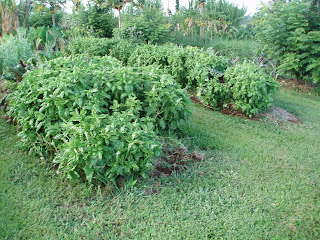
basil growing crazy

It's been a couple of weeks since my return, so I've begun to get the growth under control.  I built a fertilizer machine and a new compost pile.  My friend Kirk Deffebach built a fertilizer machine at his "franch" a few miles from us and suggested I build one for myself.  It is really an expanded Worm Farm constructed by using a piece of tin on an angled frame.  I layer grass clipping, horse manure and kitchen scraps.  I put my red wiggler worms inside and they will help the break down into compost.  Additionally, I have a bucket which collects the liquid worm juice, an excellent liquid plant food I spray on my vegetables (see earlier post on worms).  In  a month or so, I should have mature compost (humus) to add to my gardens.

fertilizer machine

A new compost pile was needed to deal with the incredible volume of green waste.  My thinking was that it was inefficient to keep moving material from the compost pile to the gardens.  Additionally, it was a waste of the nutrients escaping from the pile itself as the plants near the compost pile always grow so well.  Therefore, Drake and I cleared the surface weeds from an old raised bed and we started layering green plant material and brown plant material (dried lawn clippings) and adding horse manure.  It is already 3 feet high.  That raised bed should produce "super" vegetables in a few months.  I will continue this concept and will have to find an additional garden space by next weekend.

composting in place over raised bed garden

I want to show two of my greenhouses.  One is dedicated to tomatoes, where I have both beefsteak and cherry tomatoes.  The greenhouse protects the plants from too much rain.  Tomatoes planted outside will rot and turn brown when we get periods of extended rain.  In the greenhouse they do fine.  I prune each plant weekly, removing any sucker growth other than the terminal growing tip.  This technique forces the energy to go into fruit production verses vegetative growth.  I am harvesting half a five gallon bucket of tomatoes at least twice per week and it looks like it will continue through the summer.  I am drinking homemade tomato juice as I write this.

tomato house

This is my lettuce house, where I have red leaf, green head, and romaine lettuce.  This one house provides more salads than our family can eat.  I have a few cilantro and basil plants but won't replant them in this house again as they do so well outside regardless of rainfall.

lettuce house

Lastly, I want to share a great meal Jennifer created from our gardens.  It is a heritage tomato soup, with a dab of cream.  She put fresh tomato slices, goat cheese, and basil leaves on toasted baguette slices.

Garden based dinner


Sunday, May 22, 2011

So Much Food!

Diner, mostly from my garden

OK, the wine and cheese are purchased at the store and come from somewhere else.  But the main ingredients are from my garden ( green beans and yellow zucchini).  In fact, during the last month and a half (since my last post) our family has eaten primarily from our gardens.   In the past, and I assume like most American families, the wife asks, "what would you like for diner honey?"  And she goes to the store and buys the ingredients.  Now, we walk our gardens and see what must be harvested.  That is what determines our meal planing.  We have had so much food needing to be harvested that we cannot eat it all.

Anyone can do this!  I only work in the gardens part time on weekends!  I purchase no fertilizers, and just let the microbes do the work nature intended.

This has been a positive change for me.  I am definitely feeling better.  I know I am eating much better.  My base diet is grown naturally, without chemicals or fertilizer.  I get all the vitamins and minerals the way nature intended.  And my food is fresh, typically harvested that day, transported from my garden a few feet to my kitchen.

starter bench
Each month I plant seeds into my starter bench.  You can see peanuts, corn, sunflowers, lettuce, beets and cilantro germinating now.  It takes two to four weeks for the seedling to be ready to transplant, and when they are I transplant them into my gardens.  Then the next month I repeat the process.  I started on 1/1/11, and by April I had more food than our family could eat.

basil on 3/19/11

same garden on 5/15/11

The pictures above illustrate just how amazing natural farming is.  Look at what happened in just eight weeks.  Pesto anyone?  There is no way we can use / harvest all this.  Jennifer has made some incredible pestos.  I have it on fish, pasta, vegetables, whatever....  The same is true with our zucchini, tomatoes, swiss chard, cilantro, lettuce, kale, beets, sweet potato, squash, bok choi, and cabbage. 

Twelve pounds of cherry tomatoes,  harvested one evening
beefsteak tomatoes

How many uses can you find for tomato?  Salsa, using our cilantro, hot peppers and lime.  Spaghetti sauce, using basil and other garden spices. Soup.....

My apologies for not posting more often.  I intend to be more diligent about documenting what we are eating.  The farming is almost second nature for me now.  On weekends I'll do a little garden prep, spread some IMO's, mulch, spray with Cho's ingredients, do a little weeding.  It is so routine and so easy I don't think about it much, and as such don't feel like I have anything worth sharing.  The meals we are creating from our gardens are probably more noteworthy and something people might be interested in.

Thursday, March 31, 2011

Big Healthy Vegetables, No Fertilizer

Six Pound Zucchini
Anyone still doubting Korean Natural Farming?  I saw a small zucchini last weekend but didn't harvest it.  I  had a busy week, and only got back to check this Wednesday.  OMG, just 4 days later I found this giant.  The amazing thing is this zucchini isn't pithy or seedy.  It is excellent fruit through and through.

This was grown in a greenhouse that had tomatoes in it last year. When I prepared the garden bed last year I used IMO #4 and bio-char.  Then I grew cherry tomatoes.  They grew and grew giving plenty of fruits, but eventually became so thick with tomato vines I decided to let them die.  To do this I turned off the water thinking they would wilt and perish.  No such luck.  Three months later the plants were still thriving with NO WATER.  This amazed me, and my only explanation is that the IMO's have the ability to extend the surface area of the roots so that they could get water from outside the greenhouse.

So this year I did NOT TILL.  To prep the bed I just put a thin layer of IMO#4 over the bed, a layer of chipped sugar cane, and topped that with a thin layer of grass clippings to protect the IMO's from the sun.  I planted tomatoes ( large kind) and a few zucchini plants on March 1, 2011.  It is now March 29th and the plants are cranking.  The zucchinis are harvestable (see picture) and the tomatoes have flowered and are beginning to have small fruits.  Not tilling preserves the soil structure and allows air flow deep down into the earth.  It does not disturb the micro-organisms.  This is LIVING SOIL.

My plan is to remove the zucchini plants after they show signs of getting powdery mildew, and just grow tomatoes there.  I cut off all the new shoots on my tomato plants except the terminal ends.  The plants will get very long, perhaps thirty feet or so in length doing this method.  I'll just direct them around the greenhouse like a merry-go-round.  In theory each plant should produce 2 pounds (4 fruits) every ten days.  If they perform anything like the zucchini, I should have plenty.

Sunday, March 20, 2011

Hot Shower, Energy Independence

Sometimes I smile to myself while enjoying a hot shower knowing the water and energy is from mother nature, not the city/government.  Nothing feels as good as hot water rinsing away the dirt, making me feel totally refreshed.  Better still, we are off the grid.

Water Tank and Energy Shed with photovoltaic panels on top
Hydro generator producing 12 KW per day

30 foot waterfall on Hanawai River, 3 inch pipe borrowing a bit of water
Last night it rained several inches.  This caused the Hanawai River to rise several feet, which in turn sometimes creates problems for my hydro-electric system.  Leaves get carried into the river and these can sometimes block the screen covering the water intake.  This volume of water also means the water has lots of air bubbles.  This can create air pockets in the pipe and collect in high areas which break the syphon flow.  So I took the steep hike down to our river to do the maintenance (nothing is ever really free).

Battery Bank & Spare Hydro Generator
We generate electricity from a small 48 volt alternator.  I have a 3 inch pipe running the length of our property next to the river which has approximately 75 feet of vertical difference between the intake at the top and the generator at the bottom.  This creates about 35 psi of pressure to turn the turbine generating approximately 12 kilowatts of power per day.  This is approximately equivalent to the average US households use of electricity per day.  The intake is a simple syphon.  When the water exits the alternator it is returned to the river.  No adverse environmental impact.

Inverter 48 volt DC to 110 volt AC
I have an inverter to convert 48 volt DC power into 110 volt AC power.  I also have 8 solar panels to collect power from the sun although we really don't need them with our hydro system.  We also have a small bank of batteries to store energy.  Because the hydro system generates power 24/7, battery storage needs are minimal.

Solar Hot Water Panels
Lastly we get our own water for drinking and all our needs by collecting rain water from our house roof and storing it in a 10,000 gallon tank.  With an average rainfall over 100 inches we never run out of water. I have several filters in place including an ultra-violet light.  The water is pumped into our house by a 48 volt pump (powered by the sun and river) into a pressure tank.  We also have a solar hot water system which is powered by two panels capturing the heat from the sun.  The hot water is stored in a 120 gallon hot water tank or about 3 days of hot water use.

Pressure tank & backup diesel generator

 The cost for all of this was less than the cost of complying with our CC&Rs requiring us to run the power cables for HELCO electricity underground in conduit.  I love the independence and appreciate not getting a power bill.

Saturday, March 19, 2011

World goes to Hell, Today I planted food

New Garden, 3/19/2011
Today, Saturday March 19, 2011, I spent most of the day planting food.  CNN reported cruise missiles being fired into Libya; riots/protests in Yemen, Syria and  Bahrain; tsunami, earthquake and nuclear disaster in Japan.  My garden is how I find peace in our world.


Ariel View

This space was covered by black plastic for two years.  Back then, when we first created this garden space I used hog wire to fence off one of the few flat areas on our property (about 1/4 acre) to protect it from wild pigs.   I had a neighbor who had an Italian tractor implement called a "spader" create 4 foot wide beds. This is the same as double digging with a shovel, but much faster thanks to the power of diesel.  But I couldn't deal with all of the garden space at one time, so I covered some with black plastic film to keep the weeds from taking over.  Today, I turned the last row into a prepared garden. I used my formula of tilling in dolomite (for calcium and magnesium) and a little fish meal (think back to the Mayflower and the Pilgrims).  Then I spread Master Cho's IMO #4 over the entire bed.  I then chipped sugar cane and spread it over the entire bed at about 1 inch depth.  My thought is that the IMO will  use the sugar cane as food and multiply.  I would have covered the whole bed with grass clippings, but it rained most of the day, so I will do this when I can.  This row is over 100 feet in length.

Seedling Grow, Grow and Grow
Basil, Lettuce, Chard....


The gardens pictured above were prepared in the same way as the new one I prepared today.  I transplanted the seedlings from my seed starter two weeks ago.  The vegetables are just cranking. Jennifer asked me today what I wanted at the Hilo's Farmers Market.  I told her we needed nothing, and moreover, don't buy anything.  


lettuce seeds


One of the keys to sustainability is being able to produce your own seeds.  This picture is a purple lettuce that I let go to seed.  It bolted then produce these puff balls.  I just pulled the puff balls off into the bowl and at the base of each are seeds.  Voila, nature reproduces itself.


Saturday, February 26, 2011

Garden Update


Chicken Egg thief gets nabbed.

We have just finished transplanting our second batch of vegetable seedlings to their garden beds.  These seeds were sown in our starter box the first of February.  We started some lettuce, bush beans, basil, cilantro, tomatoes, zucchini, snap peas, and collards.  I want to plant a few zucchini every month because they get a fungus (powdery mildew) and don't last too long no matter how healthy the plant.  I love to eat zucchini so am trying this strategy, a few plants each month.  Lettuce too, they don't get fungus, but they will bolt, get tough and leggy if they get too old.  I concentrated on planting large amounts of basil and cilantro as I love pestos and making our own salsa.

We are eating from our first batch of vegetables sown on January 1, 2011.  We have regular salads from our lettuce, zucchini several meals per week, and tones of bok-choy for stir fry.  It takes about 3 to 4 weeks before transplanting, and then about 3 to 4 more weeks for the plants to be edible and producing.

I will sew more seeds this weekend including my first batch of sweet corn for the year.  That will be exciting.

Wainaku Grass being removed from Garden Bed

Double Dug Garden ready for IMO and planting
I have been spending evenings after work preparing my outside garden beds.  Drake had used some of these beds last year and let them go natural, weeds and all.  The problem here is that we have a particularly nasty weed called "Wainaku Grass".  It sends runners deep under the soil and keeps coming up and eventually takes over the bed from underneath.  The process of reclaiming these beds is slow and painstaking.  The bed must be double dug, shovelful by shovelful, and each shovelful must be deweeded, removing the white roots by hand.  These beds had been used before with the Korean Natural method so the soil structure is excellent.  There are many many worms!

I planted a bed of basil last week into one of these outside beds.  The flat of seedlings was given to me by a friend and were not looking so healthy.   We'll see if my Korean Natural Methods can bring them back.  I did my cane chipping, IMO #4 application, and grass clipping cover on several beds last weekend.  I am trying to stay ahead with prepared beds lying in wait to receive the seedlings when ready.
Basil Seedling from Friend
Basil in IMO bed

New Bed with grass clippings, pineapple in next row


I also harvested our ginger and turmeric last weekend.  Those root crops take a year to grow.  We pulled out the roots, cleaned them, and put them on a rack to dry.  Then we placed those into a paper bag in a closet to use in cooking for the rest of the year.  I will take little pieces of that harvest and plant into beds this weekend, for harvest again next year, continuing the cycle.  We make a very flavorful and cleansing drink from Ginger & Turmeric, grating then boiling it in water and finally adding a little sweetener.

Ginger Root and Orange Turmeric

Monday, February 21, 2011

Wisconsin Protests So 1980's

As a 1978 graduate of the University of Wisconsin, I am watching the protest over Collective Bargaining rights for Public sector workers with special interest.  However,  my personal opinion is that both sides have missed the mark by about 3 decades, hence so 1980's.


When all of my elite Madison friends ( ironically children of the 60's) were busy checking into the American Dream, starting work in the Public sector and beginning families and getting mortgages, us liberals lost the most critical debate of the century, that somehow global trade was good for America.  We traded jobs for cheap China goods.  Been to Wal-Mart lately?  There isn't anything made in America anymore.  When President Obama declares in his State of the Union address that to revitalize the American economy we must out-compete and out-innovate the rest of  the globe, it sounds good and we want to believe him, but he is also living in decades past.  The most innovative American company today is probably Apple (annual sales of over $20 billion), and there isn't a single device Apple makes that is made in America.

My point is that we are in a new time.  Globalization is different from times past.  Me and my elite Madison friends rode the American Dream and lived better than most kings.  But it was fueled by cheap oil, black gold, liquid carbon energy.  Because our personal lives were doing so well, it was easy to ignore and turn a blind eye to Americas global military presence insuring our oil supply.  We have allowed the Federal Reserve print money on our behalf, borrowing into the multi-trillions, to prop up our luxurious life styles.  Globalization my friends, means this is era has past.  The other folks on the globe want their share.  The American Dream is OVER, and we need to recognize this fact.

Although collective bargaining rights of public workers might seem important, it is a mute point.  It is too LATE!   We should be focusing on how to construct community in a new economic reality.  I spent the afternoon digging a garden with a shovel.  I don't expect my savings to guarantee my retirement, like prior American generations.  When every person in China gets their share of global resources, (this is the natural extension of American liberal thought), we'll be growing our own food not arguing over collective bargaining rights.  (See past post on Economic, Math and Growing your own food.)  I'm told there isn't enough copper to construct a refrigerator for every person in China currently living on our planet.  Think you'll be enjoying the retirements you were promised????.  Think again.